
Edward Phillips & The Blue: Mystical Power Trio


Posers Welcome
Is My Water Pressure Too Good?
Who Pays for the Damages?
The Hidden Gem INSIDE The Backyard
Tomorrow: Heart and Soul
The Mystical Power of the Trio

There has always been something slightly supernatural about the blues.
The music has spent more than a century collecting devils, hellhounds, crossroads, mojo, hoodoo, bad luck, temptation, sin and salvation. Robert Johnson supposedly had to sell his soul at a Mississippi crossroads just to explain how somebody could get that good at playing guitar.
Rock and roll inherited all of it.
Eventually the crossroads got electricity. The amps got bigger. Cream cranked up the blues. Zeppelin made it enormous. Sabbath made it ominous. Ozzy built an entire career wandering around somewhere between rock star and creature accidentally summoned by teenagers with a Ouija board.
Apparently we've always needed some explanation for why a few people, a few instruments and a relatively small stage can produce an amount of power that seems wildly disproportionate to the ingredients.
Thursday night, Kevin Hair offered a simpler assessment of Edward Phillips and The Blue:
“They put the power in power trio.”
He wasn't wrong.
But standing there watching them, the more interesting question became:
Where the hell does the power come from?

Because Edward Phillips doesn't particularly look like he's generating it.
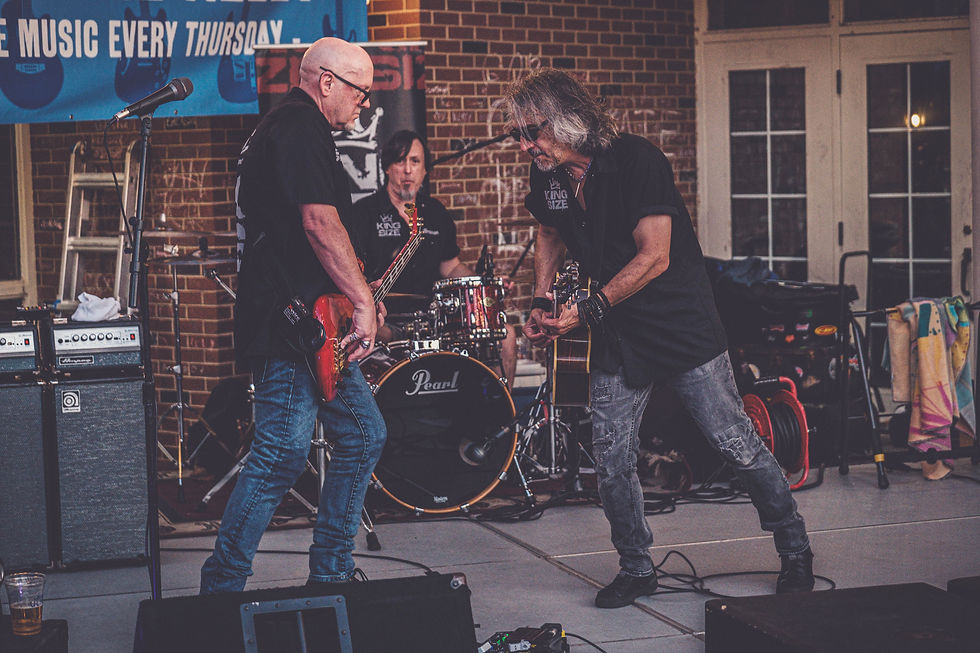
He'll be halfway through some snarling, complicated guitar run and his eyes are somewhere twenty feet beyond the end of the stage.
Watching somebody walk through The Alley.
Looking toward the back of the crowd.
Checking out whatever happens to have caught his attention.
Meanwhile, his fingers are doing things that seem like they should require considerably more supervision.
There is something almost unnerving about it. Edward plays guitar with the casual attention of a Vegas dealer shuffling cards. The difficult part stopped looking difficult a long time ago.
And Edward has put in the work to get there.
Calling him a blues aficionado probably undersells it. He has gone deep into the music, not only playing it, but studying the people who made it, where songs came from and how everything connects. He'll happily talk history, answer questions and disappear down whatever musical rabbit hole happens to open in front of him.
Somewhere along the way, all that knowledge seems to have moved from something he has to think about into something he simply inhabits.
Mike Aiken gave me a much better word for it that night.
Hypnotized.
He described watching Edward play and seemingly hypnotize himself. Then, while trying to play along with him, realizing everybody else was getting pulled into it too.
And suddenly the whole thing made considerably more sense.
Because the hypnosis doesn't stop with Edward.
Caroline Lopez looks possessed by an entirely different spirit.
There is a particular face bass players make.
You know the one.
Head down. Brow furrowed. Jaw set. The expression of someone who has just received deeply disappointing news about your competence and intends to address it through the low end.
Caroline has a magnificent one.
Then she'll look across the stage and suddenly break into this enormous smile.

The transformation can happen in seconds. One moment she looks like she wandered out of the rhythm section of a metal band that frightens parents; the next she looks delighted that everybody came to the party.
Both are apparently completely sincere.
Then she stepped up to the microphone and sang “Smells Like Teen Spirit,” because whatever boundaries we thought this blues trio was operating inside had apparently become suggestions.
Mark Howard completes the triangle from the other direction.
There are drummers who make drumming look effortless.
Mark is not particularly interested in joining them.
Every movement is sharp. Everything is wound tight. When he hits something, you can see the effort that produced the sound almost as clearly as you can hear it.
There is absolutely no attempt to make any of it look effortless.
The effort is part of the show.

Edward disappears into the music.
Caroline wears it across her face.
Mark physically pounds it into existence.
And somewhere between those three things, a power trio starts sounding considerably larger than three people.

There was another spirit hanging around the music Thursday night.
With Dolly Parton's recent passing, Edward wanted to work “Jolene” into the set.
It wasn't exactly sitting comfortably inside his normal playbook, at least not lyrically. The guitar was no problem. Put the song in Edward's hands and apparently that part can be figured out on instinct.
Remembering every word Dolly wrote was another matter.
That's what the tablet was for.
Unfortunately, the Wi-Fi had other plans.
So Edward did what someone who has spent enough time inside music apparently does when the internet abandons him.
He played it anyway.
The band pulled “Jolene” into their world, heavier and bluesier, while Edward ad-libbed his way through the lyrics he couldn't quite summon from memory.
Later, the Wi-Fi finally got its act together.
Edward went back and played it again.
This time, properly.
There's something revealing about that.
He could improvise his way through the music because that language has become second nature. But getting approximately through somebody else's song wasn't quite enough. Once he had the words, he went back and did it right.
So, yes.
Two Jolenes. One night.
Somewhere, Dolly probably would have appreciated the commitment.
The rest of the set wandered just as freely. The blues remained the foundation, but “Crazy Train” could come roaring through. Nirvana could show up. Rock and roll could stretch outward in whatever direction the three of them felt like taking it.
And, naturally, there was Cream.
They finished the song, and Edward offered his review:
“When Clapton was still good.”
Which would simply be a pretty good Edward Phillips line if he hadn't said the exact same thing after playing Cream last year.
At this point, I don't think it's a joke anymore.
It's liturgy.


Maybe that's the funny thing about all the mythology we've built around this music.
We invented crossroads and devils and mojo because sometimes extraordinary musicianship is difficult to explain from the audience.
Stand close enough, though, and you can see where at least some of the power actually comes from.
It's in the thousands of hours that make Edward's hands capable of working while his eyes wander through the crowd.
It's in Caroline locking into the bass hard enough to produce that wonderfully murderous expression before cracking into another grin.
It's in Mark making absolutely no secret of the physical work required to drive the whole thing forward.
Mike described the hypnosis from the stage.
Edward gets lost in it.
The people playing with him get pulled in.
But Thursday night, it crossed the monitors.
Lisa Kozich said Edward Phillips and The Blue “blew it out and it filled the whole Alley.”
And maybe filled is the important word.
Because Jenny Rains Rucker came to Amp that night and described something else happening in the crowd:
“We met friends from over the last 3 decades.”
That's Aiken.
Live here long enough and downtown becomes a kind of accidental scrapbook.
Somebody you knew twenty years ago is standing beside somebody you met last Thursday. Kids weave between people who have watched each other's kids grow up. Someone came specifically for the band. Someone else wandered down after dinner. Another person spots a face they haven't seen in years and suddenly the evening has acquired a completely different story.
On Thursdays, we deliberately give all of those people a reason to end up in the same place.
And, as it turns out, that place really is a crossroads.
The Alley intersects Bee Lane almost dead center in Downtown Aiken. Four quadrants radiate from the intersection, restaurants and businesses surrounding a little patch of pavement we've spent the last few years filling with bands, brands and fans.
Maybe the blues had the right idea about crossroads all along.
Not necessarily the devil part.
But the idea that there is something significant about the place where different roads meet.
Because there are other roads crossing there too.
Growing up in a town like Aiken, so many of them seem to point outward.
When you're young, you want to leave.
You want to go to college. Find the bigger city. Start the career. Meet people who didn't know you when you were twelve. Find out what exists beyond the place where everybody seems to know everybody.
Leaving is part of growing.
Then you do some growing.
And something funny happens.
The place that once felt like somewhere you needed to leave can become somewhere you want to arrive.
Some never left. Some went away and came back. Some found Aiken after growing up somewhere else entirely.
But eventually there is something awfully appealing about walking downtown on a Thursday night, hearing a guitar coming from around the corner and finding people from three decades of your life standing there waiting for you.
Maybe that's why the crossroads feels different when you're older.
When you're young, you stand there wondering which road will take you somewhere.
Later, you begin to appreciate the places where all those roads bring people together.
Thursday night, Edward Phillips stood right in the middle of one, barely looking at his guitar, somehow hypnotizing himself, the people playing beside him and eventually an Alley full of Aiken.
No devil required.
When you're young, you leave to find out who you're going to become.
Sometimes you come back because you stopped growing.
You arrive because you have.


The Alley

Is My Pressure Too good?

#### CAN YOUR WATER PRESSURE BE TOO GOOD?
There are few household complaints more universal than bad water pressure. Nobody wants to stand under a shower that feels like a reluctant rain cloud.
So when the pressure is strong, we assume that's a good thing.
Not necessarily.
If the static water pressure inside your home climbs above 80 PSI, it's high enough that plumbing codes call for a pressure-reducing valve to bring it back down.
And unlike a spectacular plumbing failure, excessive pressure can spend a long time being quietly obnoxious.
Every time you turn on a faucet, flush a toilet, start the washing machine or run the dishwasher, that extra pressure is pushing against valves, seals, supply lines and fixtures throughout the house. What feels like an impressively powerful shower can actually be extra stress on the entire system.
The strange part is how easy it is to check.
A simple water-pressure gauge can be attached to an outdoor hose bib. With the water in the house turned off, it gives you a reading of your home's static pressure. If you're flirting with or sailing past 80 PSI, the problem may be something as straightforward as a pressure-reducing valve that needs adjustment, repair or replacement.
It's the kind of problem that's much nicer to discover with a gauge than with water coming through the ceiling.
And that's the larger point behind a lot of what **Stark Plumbing** does. Plumbing has a habit of whispering before it starts screaming.
Sometimes the trick is knowing what to listen for.
**That's when you call Stark Plumbing.**
(803) 866 - LEAK

The Bud Light Stage

Who Pays When There is Fault to Share

#### WHO PAYS WHEN EVERYBODY SCREWED UP?
Here's an easy car accident.
You're sitting at a red light. Someone isn't paying attention and plows into the back of you.
Their fault.
Now let's make it more interesting.
The driver who hit you was pushed into you by another car.
That driver was speeding.
The first driver had a brake light out.
And maybe you were doing something you shouldn't have been doing too.
So... who pays?
Welcome to comparative negligence.
South Carolina doesn't require an accident to have one perfectly innocent person and one designated villain. A jury can assign percentages of fault among the people who contributed to what happened.
That percentage matters.
Under South Carolina's modified comparative-negligence rule, an injured person can generally recover damages as long as their own share of the fault does not exceed 50 percent. Their recovery is then reduced by their percentage of responsibility.
So if a jury determines you suffered $100,000 in damages but were 20 percent responsible for what happened, that can turn into an $80,000 recovery.
At 51 percent?
That's a very different conversation.
And when several people contributed to the same accident, figuring out who owes what can become considerably more complicated than pointing at the car with the crumpled front bumper.
That's part of what the attorneys at **BMG** actually do.
Because sometimes the hardest question after an accident isn't what happened.
It's **who pays for it?**

The Nooks and Crannies of The Backyard
#### WAIT. THERE'S MORE BACK THERE?
If you've been to **The Backyard**, there's a pretty good chance you've found your spot.
Maybe it's one of the tables under the trees. Maybe the deck. Maybe you've claimed a corner of the yard enough times that you're beginning to regard it as personal property.
But The Backyard has been quietly working on another little corner.
Keep walking past the main yard, through the tunnel, and the space opens again around the Airstream.
It's always been there. It just hasn't really been *used* yet.
That's changing.
The Airstream area is slowly becoming another little room without walls, with its own tables, seating tucked through the tunnel, and eventually another place to grab a drink without trekking back across the yard.
And while we've been building that out, something else has changed too.
You don't have to wait until dinner anymore.
The Backyard is now open for lunch, which means the same shady yard, hidden corners and slightly unreasonable temptation to stay longer than intended are available while the sun is still overhead.
Come find your spot.
Or keep walking.
Apparently, we have more of them.

Thursday: Heart and Soul

Last time Heart & Soul played Amp the Alley, people started staking out their spots two hours before the first note.
They had good reason.
Heart & Soul is one of those bands built for The Alley: a big, familiar catalog that can move from soul and R&B to classic rock without ever giving the crowd much reason to sit still. Stevie Wonder, Santana, Van Morrison, The Beatles, Motown, a little Mustang Sally, and plenty of room in between.
Last year, they turned Thursday night into an open-air dance floor and packed The Alley with one of those crowds that seemed to keep rising as the night went on.
So we'll skip trying to reinvent the metaphor this time.
Heart & Soul is coming back. You already know what happened last time.
And if the bag chairs start appearing around 4:30 again, consider yourself warned.


Comments